




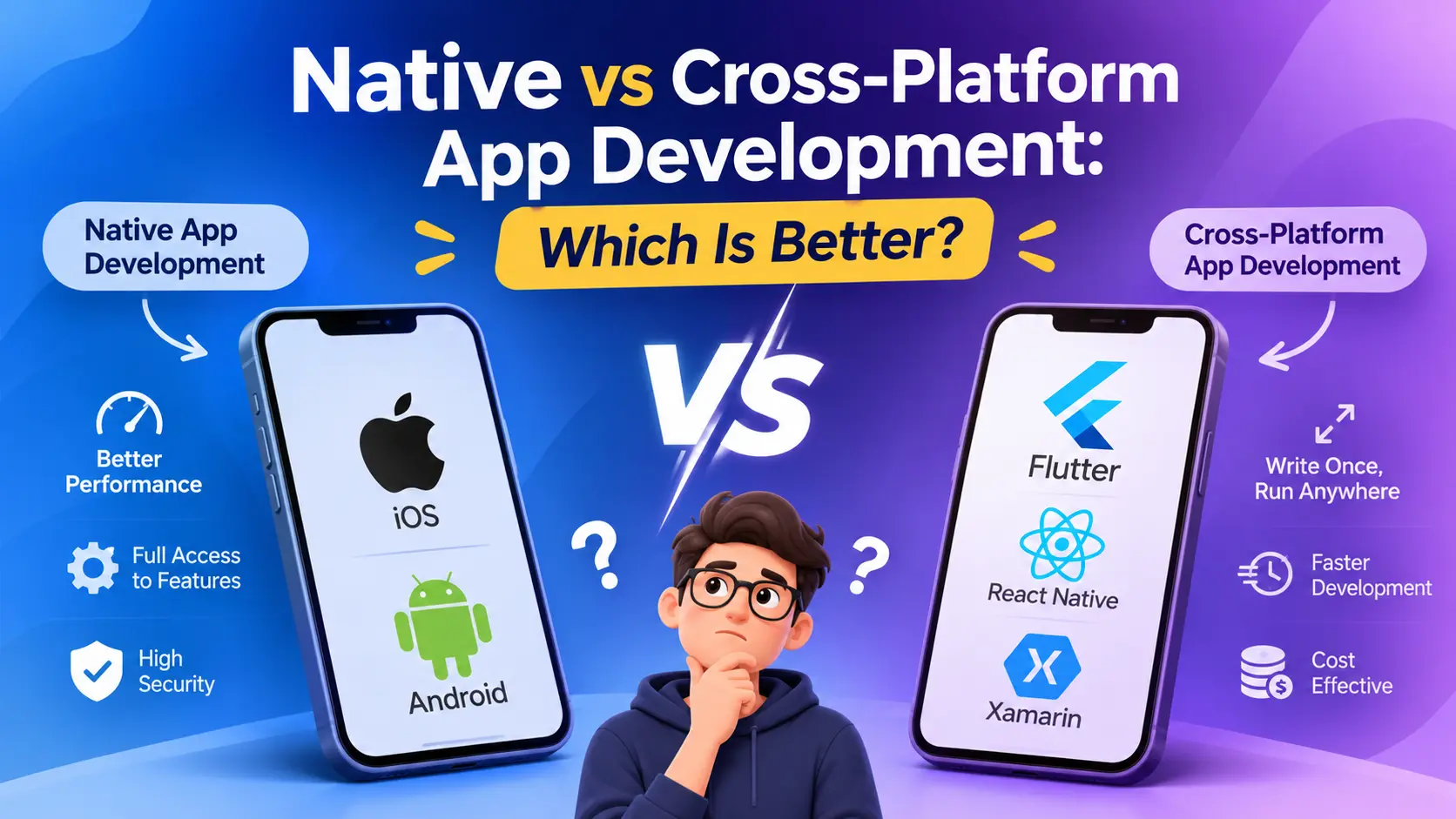
Planning a mobile application for your business? One of the first decisions is whether to build separate Android and iOS apps or develop both with a shared codebase.
The choice between native vs cross-platform app development affects development time, performance, maintenance, and the way your app works on different devices.
In this guide, we compare native Android and iOS development with popular cross-platform frameworks, including Flutter and React Native, to help you select an approach that fits your project.
What Is Native App Development?
Native app development means building an application specifically for one operating system. Android and iOS each have their own programming languages, development tools, and user interface frameworks.
Native Android Development
- Languages: Kotlin and Java
- Development tool: Android Studio
- UI: Jetpack Compose or Android Views
Native iOS Development
- Languages: Swift and Objective-C
- Development tool: Xcode
- UI: SwiftUI or UIKit
Native development offers direct access to platform APIs and design conventions. It is useful when an application needs extensive device integration, platform-specific behavior, or demanding performance optimization.
However, building and maintaining separate Android and iOS implementations can require more time and specialized expertise.
What Is Cross-Platform App Development?
Cross-platform app development uses a shared codebase to deliver applications on multiple platforms. Frameworks such as Flutter and React Native let developers reuse business logic and many interface components across Android and iOS.
Flutter
Flutter is a framework developed by Google. It uses the Dart language and a widget-based rendering system, giving developers substantial control over custom layouts and animations.
React Native
React Native, developed by Meta, uses React with JavaScript or TypeScript. It renders native platform views and is a practical option for teams already experienced with React.
Cross-platform development can reduce duplicated work, but developers may still need platform-specific code for certain integrations, permissions, and new operating system features.
Native vs Cross-Platform: Key Differences
Here is a practical comparison of native vs cross-platform mobile app development:
| Feature | Native | Cross-Platform |
|---|---|---|
| Development approach | Separate platform implementations | Shared codebase with platform-specific additions |
| Languages | Kotlin / Java / Swift | Dart / JavaScript / TypeScript |
| Performance | Direct platform optimization | Strong for many business applications |
| Development time | Often longer for two platforms | Often shorter with code reuse |
| UI experience | Tailored to each platform | Can maintain a consistent design |
| Device integration | Direct platform APIs | Plugins, libraries, and native modules |
| Maintenance | Two platform codebases | More shared code to maintain |
| Best suited for | Platform-intensive apps | Many business apps and MVPs |
These differences are general patterns, not guarantees. Actual cost, performance, and delivery time depend on project scope, implementation quality, and team experience.
Flutter vs React Native
Both Flutter app development and React Native app development support Android and iOS, but they use different technologies.
- Flutter: Uses Dart and its own widget system; often preferred for highly customized, consistent visual interfaces.
- React Native: Uses JavaScript or TypeScript and React; can suit teams with existing React expertise.
- Both: Support device integrations, navigation, APIs, and production mobile applications.
Explore the official Flutter documentation and React Native documentation for more technical details.
Performance and User Experience
Native applications offer direct access to platform-specific optimization tools. This can be especially useful for advanced graphics, specialized hardware, or complex background processing.
Modern cross-platform applications can also provide smooth experiences for common features such as login, booking, e-commerce, dashboards, notifications, and API-based services.
A well-architected app often matters more than the framework alone. Network efficiency, memory management, state handling, and testing all influence the user experience.
Development Time and Maintenance
If your business needs both Android and iOS apps, a shared codebase may reduce duplicated development and make it easier to release common updates.
Native development gives teams more independent control over each platform, but feature changes may need to be implemented twice. Cross-platform teams still need to test on both systems and maintain platform-specific dependencies.
Before deciding, estimate the total effort across design, development, testing, store submission, and future updates—not just the initial coding phase.
When Should You Choose Native?
Consider native Android or iOS development when your project depends heavily on platform-specific APIs or needs specialized behavior that cross-platform libraries do not support well.
- Advanced camera or media processing
- Complex Bluetooth or hardware integrations
- Graphics-intensive applications
- Deep operating system integrations
- Distinct platform-specific user experiences
These are reasons to evaluate native development, not automatic requirements. Some such features can also be built with cross-platform frameworks and native modules.
When Should You Choose Cross-Platform?
Cross-platform development is often attractive when you want to reach both Android and iOS users efficiently and most features can be shared.
- E-commerce and product catalog apps
- Hotel and travel booking apps
- Education and learning platforms
- Appointment and service booking apps
- Customer portals and business dashboards
- Startup MVPs and early product launches
If you are still deciding whether you need an app at all, read our guide to websites, web apps, and native mobile apps. You can also explore Progressive Web Apps (PWAs) as another option for app-like web experiences.
How to Choose the Right Approach
Start with the business problem rather than choosing a technology based only on popularity. Ask:
- Do we need Android, iOS, or both?
- Does the app require specialized device features?
- How important is a unique interface on each platform?
- What skills does our development team already have?
- How frequently will we release updates?
- What is our long-term maintenance plan?
A requirements review and small technical prototype can help reveal platform limitations before major development begins.
How Webcoder Can Help
At Webcoder, we help businesses explore digital solutions based on their goals, users, and technical requirements.
Whether you are considering native Android development, native iOS development, Flutter, or React Native, the right starting point is a clear plan for features, design, integrations, and ongoing support.
Learn more about Webcoder mobile application development services and discuss an approach suited to your business.
Frequently Asked Questions
1. What is the main difference between native and cross-platform development?
Native development builds separate platform-specific apps, while cross-platform frameworks allow much of the code to be shared across Android and iOS.
2. Is Flutter better than native Android?
Flutter is useful for cross-platform code reuse and custom interfaces. Native Android offers direct access to Android-specific APIs. The better choice depends on your requirements.
3. Which is better: Flutter or React Native?
Both are capable frameworks. Flutter uses Dart and its own widget rendering approach, while React Native uses React and native platform views. Team expertise and integrations should guide the decision.
4. Is cross-platform development always cheaper?
No. Code sharing can reduce duplicated work, but costs depend on complexity, native integrations, testing, and ongoing maintenance.
5. Can Flutter and React Native access phone features?
Yes. Both can use cameras, location, notifications, and other device capabilities through plugins or native code, although some integrations require additional work.
Conclusion
Choosing between native vs cross-platform app development depends on your product goals, platform requirements, timeline, and available resources.
Native development offers deep platform control. Flutter and React Native can make multi-platform development more efficient through code sharing. Both approaches can deliver reliable, professional mobile applications when implemented well.
Planning your next mobile app? Visit Webcoder to explore a development solution that fits your business.