




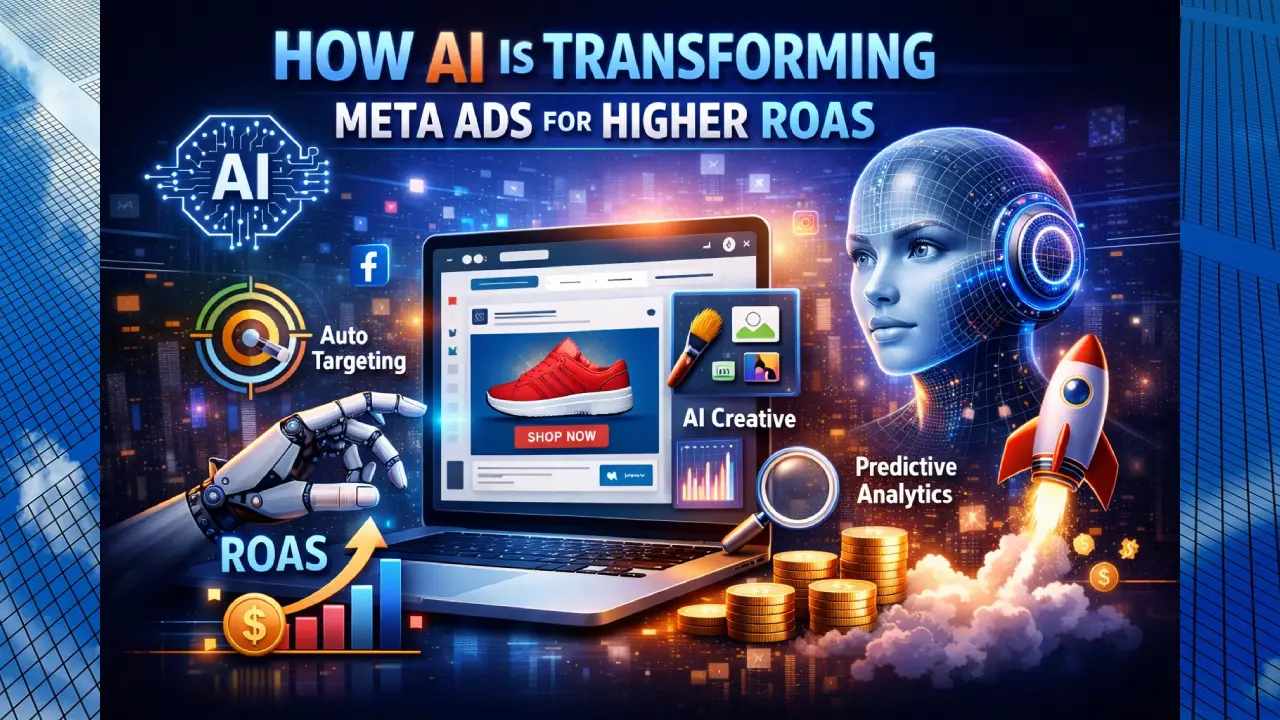
Digital advertising has changed dramatically in recent years. What once relied on manual targeting, frequent guesswork, and constant monitoring is now powered by artificial intelligence. For businesses running Facebook and Instagram ads, achieving a higher Return on Ad Spend (ROAS) is no longer about experimentation alone—it’s about how effectively AI is used.
Brands working with a digital marketing company in Dehradun are seeing this shift clearly. Rising competition and increasing ad costs mean that Meta ads must work smarter, not harder. AI has become the foundation of high-performing advertising strategies.
This blog explains how AI is transforming Meta ads, why it matters for ROAS, and how businesses can use it strategically rather than blindly.
The AI Revolution Inside Meta’s Advertising Ecosystem
Meta has invested heavily in artificial intelligence and machine learning to power its advertising platform. Today, AI influences almost every decision—from who sees your ad to how much you pay for each impression.
Earlier, advertisers manually defined audiences, controlled bids, and shifted budgets after reviewing reports. Now, Meta’s AI systems continuously learn and adapt in real time, analyzing thousands of signals per second.
At the center of this transformation is Meta’s Advantage+ ecosystem. It automates targeting, creative testing, and budget optimization, replacing slow manual decisions with instant data-driven actions.
This shift has redefined performance marketing and explains why businesses increasingly depend on structured strategies rather than trial-and-error ad management.
Predictive Audience Targeting Beyond Basic Demographics
One of the most powerful changes AI has introduced is predictive audience targeting.
Traditional targeting relied on demographics and interests. AI goes much deeper. It evaluates behavioral signals, purchase intent, engagement history, device usage, and content interaction to predict who is most likely to convert.
Meta’s AI identifies patterns that humans often miss. Your ads reach people who behave like your best customers, even if they don’t match traditional targeting assumptions.
For businesses selling products or generating leads, this dramatically reduces wasted spend and improves ROAS. This is why companies partnering with the best digital marketing company in Dehradun often see stronger performance compared to businesses running ads without strategic oversight.
Dynamic Creative Optimization at Scale
Creative testing has always been critical to advertising success. AI has completely changed how this works.
Instead of testing a few ad variations, Meta’s AI tests hundreds of creative combinations simultaneously. Headlines, visuals, videos, copy, and calls to action are dynamically mixed and matched.
The system learns:
-
Which creatives work for different age groups
-
Which formats perform best on Facebook versus Instagram
-
Which messaging converts better on mobile devices
-
Which creatives perform at different times of the day
Each user sees the version of the ad most likely to drive action. This personalization at scale leads directly to higher conversion rates and improved ROAS.
Real-Time Budget Allocation
Manual budget management often causes wasted spend. AI eliminates this inefficiency.
Meta’s AI continuously monitors ad performance and reallocates budgets in real time. If Instagram placements outperform Facebook feeds on a given day, spending automatically shifts. If a specific audience starts converting better, budget follows instantly.
This ensures that:
-
No money sits in underperforming ad sets
-
Short-term opportunities are captured immediately
-
Every rupee works harder
For performance-focused advertisers, this is one of the biggest drivers of efficiency.
Predictive Analytics and Conversion Forecasting
AI doesn’t just respond—it predicts.
Meta’s machine learning models forecast conversion probability using behavior patterns, time-based trends, and historical data. This allows the system to bid more aggressively for high-intent users and reduce spend on low-intent ones.
Over time, the system learns your business cycles, seasonal trends, and customer lifetime value. This predictive intelligence is essential for maintaining stable ROAS at scale.
Automated Bid Strategies and Value Optimization
Ad auctions are complex and happen in milliseconds. AI-powered bidding removes that complexity.
Meta’s automated bid strategies calculate the optimal bid for every impression based on conversion likelihood, competition, and expected value. For value-optimized campaigns, the system prioritizes higher-value customers rather than cheap conversions.
This approach is especially useful for businesses offering premium services or higher-ticket products. Many advertisers combine this with broader digital marketing services such as landing page optimization and analytics to maximize profitability.
Why AI-Driven Meta Ads Matter for Indian Businesses
India’s market presents unique challenges: regional diversity, mobile-first behavior, varying internet speeds, and different purchasing habits.
Meta’s AI adapts automatically. It optimizes creatives, formats, and delivery based on region, device capability, and user behavior. For businesses targeting both local and national audiences, this eliminates the need for fragmented manual campaigns.
This is why AI-driven Meta ads are now a core component of modern performance marketing strategies.
Human Strategy Still Matters
AI is powerful, but it does not replace strategy.
AI needs:
-
Clear business goals
-
High-quality creative assets
-
Accurate conversion tracking
-
Well-optimized landing pages
Without these fundamentals, automation cannot deliver results. This is where working with an experienced SEO company in Dehradun that understands both organic growth and paid advertising becomes valuable.
At Webcoder, AI-driven advertising is paired with strategic planning, creative testing, and data analysis so automation supports real business outcomes—not just vanity metrics.
The Path Forward
AI is no longer optional in Meta advertising. Businesses that embrace it outperform those relying on manual optimization.
Campaigns using Advantage+ features and automated optimization consistently deliver higher ROAS than traditional setups. Data across industries shows improvements of 20–30% when AI is implemented correctly.
The future belongs to advertisers who combine automation with strong strategic direction.
Final Thoughts
AI has fundamentally transformed Meta ads. From predictive targeting to creative optimization and real-time budgeting, artificial intelligence now drives high-ROAS advertising.
Businesses that adapt early gain a clear advantage. Those that resist face rising costs and declining efficiency.
As a digital marketing company in Dehradun, Webcoder helps brands align AI-powered Meta ads with clear strategy and measurable results. When automation and human insight work together, advertising becomes scalable, predictable, and profitable.